

For Support and Resources, click here.
Discovered and organized by Oliver and Rachel DeMille, Thomas Jefferson Education, or “TJEd,” is an educational philosophy and a methodology by which great individuals throughout history were educated.
Thousands of families and professional educators are applying those same principles today, with amazing success.
To learn more, you can scroll down to read this brief overview article in order, or click on a content link to choose your topic.
Contents:
“All men who turned out worth anything have had the chief hand in their own education.”

What is a great education?
- Is it good grades and high test scores?
- Is it memorization/regurgitation of facts and dates?
- Is it measured by how much income one can earn, by how much political power one can amass, or by popularity?
“Education can’t be fixed as long as we believe this basic myth. The myth is that it is possible for one human being to educate another. The fact is that the only person who can fix education is the student.”
“…Great teaching will solve our educational problems… Teachers teach and students educate… There are two types of great teachers which consistently motivate student-driven education: Mentors and Classics.”
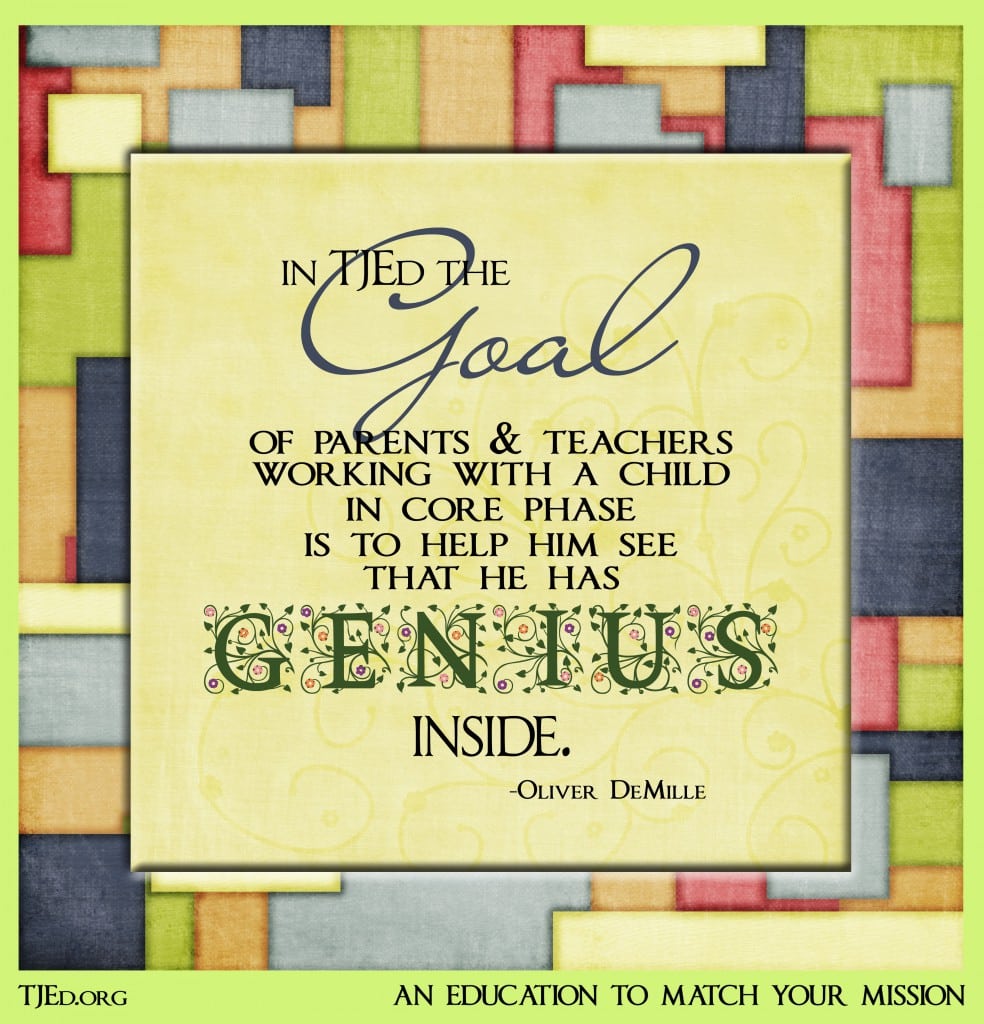
Every person has inner genius. Thomas Jefferson Education consists of helping each student discover, develop and polish her genius. This is the essence and very definition of great education.
There are really only three kinds of education, and they are best understood from the student’s perspective. Students get a good education for one of three reasons:
- they are forced to study long, hard and effectively (the “Stick”)
- they are convinced or manipulated to study long, hard and effectively (the “Carrot”)
- they love to study long, hard and effectively (the “Love Affair”)
If the first two are “good,” the latter is truly “great.”
The Stick, the Carrot, or the Love Affair–these are the three types of education; and the love affair is by far the most effective.
Sticks, Carrots and Love Affairs

The carrot and the stick are mediocre forms of education. Only a true love affair with learning helps students discover their great inner genius, effectively develop it and greatly refine it to become their best and to deeply benefit society.
Why would anyone not follow this path? Because they were forced or convinced to do otherwise.
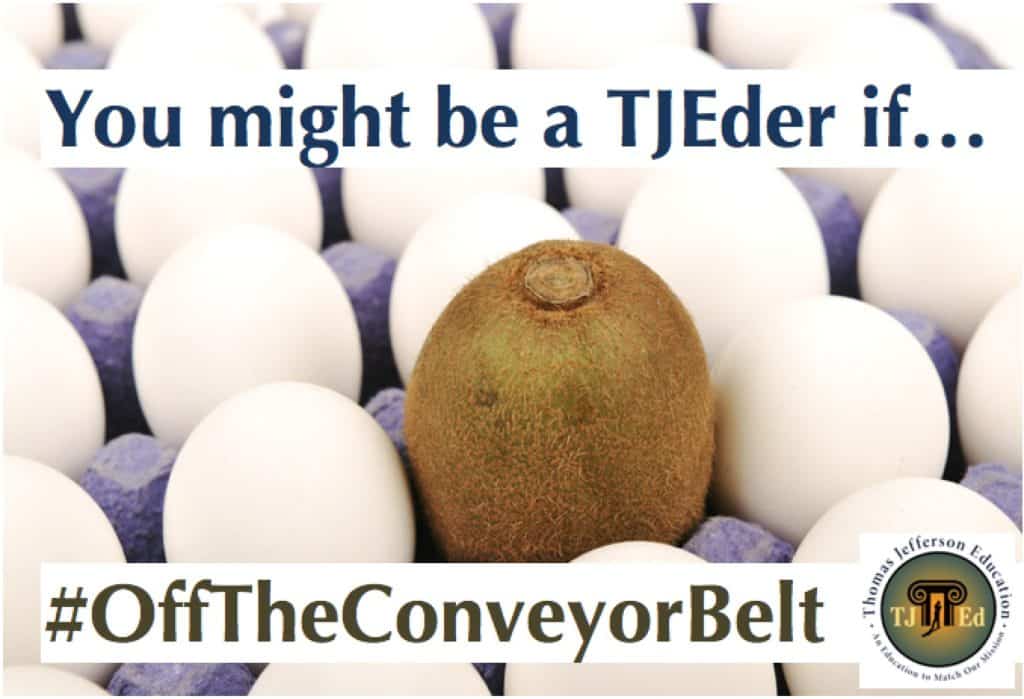
The educational conveyor belt attempts to bring all students to literacy by compelling parents and children to meet certain standards. Everyone is herded in the same direction, required to conform by fear of not measuring up.
The professional conveyor belt promises special rewards to the few who rise above the masses and follow a different assembly line (still conformist, but based on incentives rather than punishments) to gain higher compensation, status and perks. Too often the result of both belts is widespread mediocrity and many dysfunctional lives and societies.
For great education to occur, students must choose to study long, hard and effectively because they genuinely love it! It must be their passion and their delight. When students are deeply in love with studying, they learn in “the flow” and they absorb massive amounts of information, knowledge, understanding, connections and wisdom in a very short time.
In this introduction to Thomas Jefferson Education, or “TJEd,” as it is commonly called, we will review the Three Systems of Education, the Phases of Learning and the 7 Keys of Great Teaching. Please note that you can access free download audios of convention talks on these subjects here.

There are three major types of education in America today. These same models can be found around the world and throughout history, with identifiable models and objectives. They are:
- Conveyor Belt
- Professional
- Leadership
Each has its own goals, curriculum and methods, with a particular career or life path as its objective. You can read a commentary on these in A Thomas Jefferson Education; they are summarized here:
Conveyor Belt Education

The modern public school system was set up about the same time as the industrial revolution with the intent to educate the poor so that they could get a job, and thereby support their families.
Each person who travels through the conveyor belt receives a stamp of approval at the end (diploma), and comes out into the world as a “finished product,” ready to be marketed to the highest bidder for employment. And like a factory, conveyor belt institutions test and grade all students on the same scales regardless of individual needs or interests.
The Conveyor Belt does precisely what it was designed to do. It produces a relatively literate workforce for the general populace. It is not designed, however, to produce independently thinking leaders.
Conveyor Belt education can be found in public schools, private or charter schools, and even in home schools. It is sometimes referred to as the “soviet conveyor belt,” because standards and grade levels are set low enough to ensure that nearly everyone can make it through the educational assembly line.
Conveyor Belt Education has as its objective to prepare everyone for a job, any job, by teaching them what to think. This includes rudimentary skills to help them function in society. In general, compulsory schools are set up on the conveyor belt model, although most of us can cite wonderful examples of many excellent teachers in the public system who use leadership methods.
…Conveyor Belts have an important place in society, but it is essential that they don’t become a monopoly and that professional and leadership training schools are maintained.
Goals:
- Educate the Masses and Lower Classes
- Teach What to Think
- Get a Job
Curriculum:
- 85% Social
- 15% Textbooks
Method:
- “Soviet” Conveyor Belt—Schools look and run like factories
- Individual intiative and innovation from students (non-conformity) is discouraged
- Individual initiative and innovation from educators is discouraged
Careers: (According to age)
- 0-12 Study
- 12-18 Play
- 18-24 College Major/Job
- 24-68 Work/Job
- 68+ Retire or Volunteer

Professional education systems create specialists by teaching their students when to think. This model has been used much longer than the soviet conveyor belt, since it arose from the tradition of apprenticeship, where the student was systematically taught what his master knew before venturing out on his own.
Each professional, whether a mechanic, a lawyer, a doctor, or a financial adviser, is trained to meet a certain set of standards and to think creatively within his field of expertise. However, outside of that narrow scope of knowledge, he tends to rely on the understanding of other experts. A complex society such as modern day America reinforces this.
Professional education is also known as the “competitive conveyor belt,” since the methods usesd are the same as the soviet conveyor belt, but the standards are set much higher—the top 10-15%.
The professional system does what it’s designed to do—create expertise. And if you need a doctor, a lawyer, or a manager for your business, you are glad they are well prepared. The professional system has been very effective in achieving its goals, but it is not a substitute for leadership training.
Goals:
- Train Experts
- Teach When to Think
Curriculum:
- 50% Case Studies
- 50% Ethics
Method:
- Competitive Conveyor Belt—Students Compete
Careers: (According to age)
- 0-18 Play
- 18-22 College Major
- 22-26 Professional Training
- 26-65 Career
- 65+ Retire or Volunteer
Leadership Education

Leadership Education has three primary goals.
First, to train thinkers, leaders, entrepreneurs, and statesmen—those with understanding and competence to lead society (do things right) and the moral character to act with integrity in the areas they lead in (do the right thing).
Second, to perpetuate freedom by helping people understand what freedom is and what must be done to maintain it, and inspiring them to actually do the difficult things required to make it happen.
Third, teach students how to think, which is how the first two goals must be accomplished. Those who know how to think are able to lead effectively and help a society remain free and prosperous, while those who know only when or what to think will be unable to do so.
The method for training leaders is as old as humanity—classics and mentors. The student studies the greatest works ever created, and submits to the guidance of great mentors, who customize the education for the student’s mission in life.
This is the simplest, though arguably the most challenging of the educational paths.
“Leadership Education, which I call ‘Thomas Jefferson Education,’ teaches students how to think and prepares them to be leaders in their homes and communities, entrepreneurs in business, and statesmen in government.
“…What happens when a society does not prepare leaders? We get managers and professionals leading in areas they have no training for, such as government, and we get a nation of followers who see no problem with that because they have no experience with anything else. …This was the legacy of Germany in the 1930s—a highly trained but uneducated people easily swayed by Hitler.”
Goals:
- Raise Great Souls
- Cultivate Leaders
- Teach How to Think
Curriculum:
- Classics (any works that inspire greatness and are worth revisiting time and time again)
Method:
- Mentors that Design a Custom Education for Each Student
Careers: (According to age)
- 0-12 Play/Family Work
- 12-16 Scholar Phase
- 16-20 Superb Education
- 20-24 Depth Phase (Liberal Arts College)
- 24-50 Build Two Towers (a Family and an Organization)
- 50+ Impact the World (Statesmanship)
The Phases of Learning
[This is a brief overview. For more on the phases, click here.]

One of the most significant differences between Thomas Jefferson Education and other classical styles of education has to do with the belief that people, especially children, learn differently at different ages. Thus, there are different phases for learning certain lessons.
Some of the greatest researchers in childhood behavior (Jean Piaget, Erik Erikson, and Dr. Raymond and Dorothy Moore) agree that children pushed academically at an early age tend to burn out early in adulthood, or long before. Young children do soak up learning like a sponge, but at what cost are children pushed into academic work too soon?
A hate of learning is developed when children are forced to perform at a young age and blooms precisely at the time when non-pressured young minds have the potential to be the most curious and inquisitive! And if children of a very young age soak up knowledge so easily, shouldn’t they be learning the most important lessons of love, work, and faith during their most formative years, rather than filling their heads with random facts and figures their minds are unable to yet comprehend?
Children normally are not mature enough for formal school programs until their senses, coordination, neurological development, and cognition are ready. Piagetian experiments have shown repeatedly that cognitive maturity may not come until close to age twelve. Interestingly, the ancient Orthodox Jews, known over the world for their brilliance, provided little or no formal schooling until after age twelve for girls and thirteen for boys when children were considered able to accept full responsibility for their actions.
A child in Core Phase should:
- Learn the difference between good and bad, and how to make good choices
- Learn how to work, and how to be responsible
- Learn about God and his or her relationship with Him
- Play—which is the best way for a child to learn about the world around him
- Spend most of his time at home with his family, being nurtured and loved
Love of Learning (approximately ages 8-12)

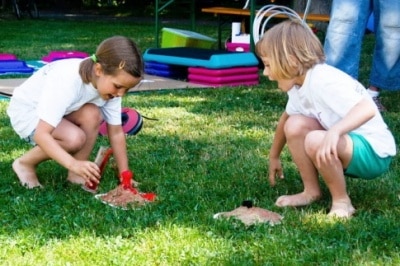
The Love of Learning Phase is the second of the two Foundational Phases, and it sets the stage for the child’s later scholarly pursuits. This is when a child begins to play in new ways, and this sometimes begins to look like study, but maintains the spontaneity and curiosity of play.
If a child at this stage (or earlier) is forced into academics, what results is usually a “Hate of Learning.” This is one of the earmarks of a conveyor belt education, and why most of us schooled that way can’t fathom the idea that young adults will eventually choose to study 8-10 hours a day, if this phase is successfully nurtured.

This is a time when the student-in-embryo is encouraged to learn about anything that interests her. The parent’s job is to help provide an environment rich in resources and exemplify curiosity and personal growth by choosing meaningful personal study; the child will follow suit.

If she chooses it, she’ll be excited about it, and so her play will include things that sometimes do and sometimes don’t look like work: reading, writing, discussing, drawing, sculpting, building, cooking, and cleaning. The parent’s job during this phase is to keep the home stocked with “educational products,” and model to the child that learning is one of the “funnest” things she can possibly do.
“Following a successful Core Phase, a child will naturally transition to what we call ‘Love of Learning.’ During this period, a child will commonly play at projects and skills which builds his repertoire of understanding and prowess. During Love of learning, which typically runs more or less between the ages of 8-12 (often earlier for girls than for boys), the time in the day devoted to learning will gradually increase over time to a number of hours a day by the time a student transitions to Scholar Phase. …The TJEd home will facilitate a successful Love of Learning Phase as parents and older siblings model the behaviors of study, self-discipline, passion for learning, a sense of personal mission and a habit of service in and out of the home.”
A child in the Love of Learning Phase (who has had a solid Core Phase) will:
- Study what they are excited about, with minimum “requirements” or “assignments” and maximum inspiration
- Be fascinated by a variety of subjects, and will move from one subject to another at a random pace
- Grow to love learning, if they are free to follow their interests (and conversely, grow to hate learning, if forced and coerced in academics before they choose)
- Continue to learn and add upon the lessons of Core Phase
Educational Phases: Scholar and Depth

As the student nears the culmination of a successful Love of Learning phase, he naturally begins to transition towards more scholarly pursuits, until he enters the Scholar Phase, the first of the Educational Phases. Within Scholar Phase, there are a number of different levels built one upon another. During the scholar phase years, the student develops and changes so quickly, that what works for a child in the beginning of Practice Scholar will not necessarily work for the serious Self-Directed Scholar.

In all of Scholar Phase, parents need to be careful not rob their scholars of study time. Chores and other duties in the home are needed, but these responsibilities should be lessened by degrees to give the scholar more time for his or her chosen studies. Parents also need to realize that the amount of time a scholar spends alone in their room is an indication that the student is studying.
Pulling them out of that solitary time to play, socialize, or have fun sends mixed messages about the importance of study. Parents sometimes forget that our scholars are doing their best to begin the hard work needed in order to get a superb Thomas Jefferson Education. Because of a nurturing Core Phase and a carefree Love of Learning Phase, these scholars experienced a great childhood, and are now ready to dig in and do the adult work needed for Scholar Phase.
“Scholar Phase (often, but not always, from ages 12-16) typically ensues with the onset of puberty and is marked by a change in the student’s physical, emotional and social expression. With these changes come a readiness to apply a new level of effort to personal and academic achievement through a process of commitments and accountability. …[It] is a time to study “everything under the sun,” to read, study science and math, practice art and study the great artists, and cover every topic and subject in a spirit of passion and excitement for learning.”
Practice Scholar
This is the time of life when children re-learn everything they’ve been taught, but now as their own person, rather than as an extension of their parents. They are coming to the realization that they have a unique mission for their life, even though they do not yet know what that mission is. They are beginning to spend real time studying, their attention span is increasing, and they are learning to be more responsible.
Apprentice Scholar
Apprentice scholars are taking the next steps needed to move forward in their educations. They realize that they truly do have something unique to offer the world, and have a greater desire to find out what that entails. They are more committed to, and have more self-initiative in, their studies. They can more easily inspire themselves, and begin to lead out more among their peers and siblings.
Self-Directed Scholar
These scholars have experienced personal change from exposure to many classics, and are ready to have real impact in the world. These students begin to feel a strong pull in one direction of study, and realize that they want to sink deeper in this chosen subject. They are creating their own plans for their studies, and have solid self-discipline to follow through and answer to their own plans. They begin seeking a mentor outside the home, and are ready to make the full commitment needed for a full mentorial experience.
“He [the scholar] has watched you (and maybe older siblings and your spouse) study math, science, history, literature, government, writing or whatever else you think everyone should learn, and so he makes these part of his Love of Learning study. He anticipates that in Scholar Phase he will gain further knowledge in most, if not all, of these areas.
“…And because of the way you have studied and shared and involved him, he is familiar with, or at least aware of, the subjects you are sure he will need…
“If this does not describe your child, more time in Core or Love of Learning is probably needed. Relax; it is still “You, not Them.” Or, more accurately, stop relaxing and get to work—on you, not them.”
Young adults in Scholar Phase (who have had a solid Core Phase and Love of Learning Phase) will:
- Study 8-12 hours a day in subjects that interest them
- Willingly submit to a demanding mentor to “fill in the gaps”
- Feel passionately driven by a sense of “mission,” even though they are might not yet be sure what that mission is
- Immerse themselves deeply in subjects of their own choosing that the they feel will help them in their life’s mission
- Need time to study and read on their own
Depth Phase

Depth Phase is the second of the two Educational Phases, and as the name suggests, it is where the student digs deeper into the great wealth of learning available. Where the presence of a mentor is required to enter Scholar Phase, submitting to a more demanding mentor is critical to an effective Depth Phase. It is this mentor who will personalize the course of study for the individual mission of the student, filling in gaps and exposing weaknesses that the student must address.

Depth Phase usually takes place in a college setting—ideally one which employs all five of the Pillars of Statesmanship (Classics, Mentors, Simulations, Field Experiences, and God). This environment is important for the student to learn the central lessons of Depth Phase:
- Initiative—acquire the ability to create, to add value, to increase what was given
- Ingenuity—develop the ability, skill, and habit of doing things well
- Integrity—don’t just do things right, do the right things
- Allegiance to God and/or Good—build upon and expand this attachment, giving yourself to your allegiance
- Commitment to Mission—clarify your purpose in life, and then passionately dedicate your time to that purpose
- Passion—engage with energy in accomplishing great things, even if they seem small or simple at the time
- Impact—make a real difference
- Breadth—study widely in many fields
- Depth—study a few topics in real depth, gaining mastery, expertise, and true understanding
- Nuance—cultivate the ability to analyze, discern, see contrasts and simultaneously understand similarities, and think
“Depth Phase (ideally between 16-22) is characterized by a profound hunger to prepare for on-coming responsibilities and future contributions in society. This hunger leads a Scholar to acknowledge his or her limitations, and the limitations of the current mentorial arrangement, and to submit to the grueling expectations of a mentor at a new and higher level. For most, this is best accomplished in a college setting.”