

Below is a sample week from April 12-18
April 12
1877: James Tyng, a Harvard catcher, wore the first face protector in baseball.

His wire mask, called a “bird cage,” was designed by coach Frederick Thayer. It was patented and became a forerunner of today’s catcher’s mask.
- What other sports use protective gear?
- Why is it necessary?
- Do you have rules regarding safety while you’re playing (trampoline, bicycle, swimming, etc.)?
- What special safety issues exist in the area where you live? (extreme weather conditions, predatory wildlife, crime, etc.)
- How do these concerns affect your choices?
- How do they impact family’s rules?
- Design protective gear (Go ahead! Be impractical, silly, outlandish..) that would have saved you from some mishap you experienced.
This Week in History helps you “Inspire.”

Also on this date in history:
1961: First man in space.
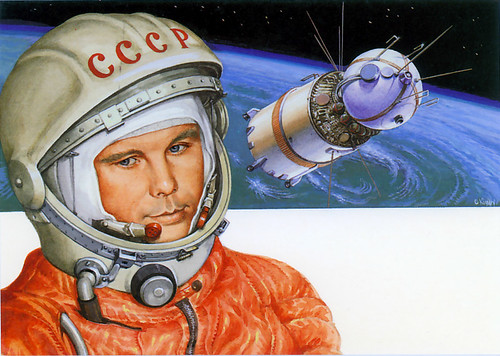
Yuri Gagarin, a Soviet cosmonaut, became the first man in space. He made one orbit of the earth aboard the spacecraft Vostok I.
Resources:
- Russian Archive: Gagarin’s life in picture and prose
- Soviet National Anthem
- Fan article on Gagarin
- Soviet propoganda brochure (Really cool cultural piece! It’s translated from Russian, so the English is sometimes a little awkward–but I think that’s part of the charm.)
- The First Man in Space (Days That Changed the World), Cullen
- First Space Encyclopedia (DK First Reference) (DK Publishing)
Ideas for discussion and research:
- What type of training and preparation do you think was required for Gagarin to go to space?
- This is an achievement for which the Russian people are justifiably proud. What is your impression of the “propaganda” brochure?
- Are you familiar with other historical propaganda from your own homeland? From other countries?
- How do they differ? How are they similar?
- What is propaganda?
- Do you identify with Gagarin’s feat as a human achievement, or as the special honor of a particular country? Why?
- What other countries have space programs?
- What advances in space technology are attributable to which countries?
- Our culture tends to celebrate “firsts”. Do you think the achievement of the second and sixteenth man in space is of lesser importance? Why or why not?
- Is there a dream you wish to achieve in your life that requires your preparation now?
This Week in History develops cultural literacy.
April 13
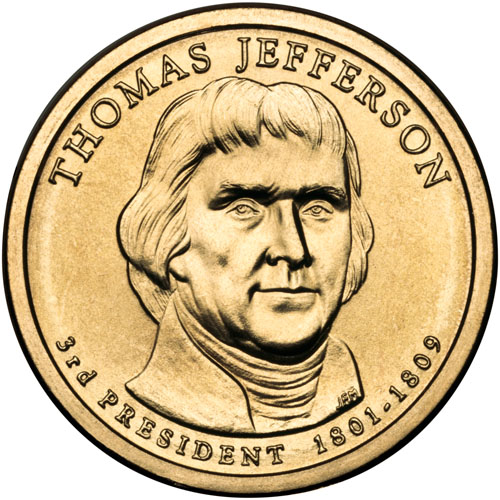
1743: Birthdate of Thomas Jefferson
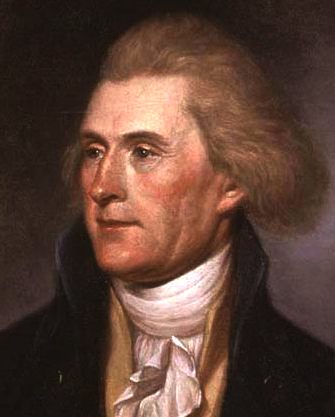
Born in: Albemarle, Virginia
Occupation: Farmer, Lawyer, Public Official
U.S. President: 1801-1809
Died: July 4, 1826 in Monticello Virginia
About Jefferson:
- Spoke Latin, Greek, Italian, French and Spanish
- One of the authors of the Declaraion of Independence
- Founded Democratic-Republican Party
- Amateur scientist, architect, inventor, and book collector
During his terms:
- Ended much of the pomp and circumstance surrounding the presidency, including national celebration of presidents’ birthdays
- Authorized the Louisiana Purchase and the Lewis and Clarke expedition
- Helped plan Washington, D.C. building styles
- Tripolitan War against pirates in the Mediterranean concluded
- Protested British seizures of American ships and seamen
Resources:
- Study sheets on political, social, intellectual, personal and religious freedom
- On writing the Declaration of Independence
- Love this one: A More Perfect Union: America Becomes a Nation, DVD
Books by and about Jefferson:
- Thomas Jefferson, Harness
- A Picture Book of Thomas Jefferson (Picture Book Biography), Adler & Wallner
- Thomas Jefferson: Architect of Democracy, Severance
- Autobiography of Thomas Jefferson
- The Jefferson Bible: The Life and Morals of Jesus of Nazareth, Jefferson
- The Life and Selected Writings of Thomas Jefferson (Modern Library Classics), Jefferson; edited by Koch and Peden
- The Declaration of Independence and Other Great Documents of American History 1775-1865 (Dover Thrift Editions) (Dover)
- The Declaration of Independence: The Story Behind America’s Founding Document and the Men Who Created It (Museum in a Book) Gragg
And DON’T miss this one:
- The Real Thomas Jefferson (American Classic Series), by Andrew Allison
Activities
- “A Delightful Recreation” What was Jefferson’s idea of a good time?
- Jefferson-style parlor games
- Thomas Jefferson and His Family Paper Dolls in Full Color, Tierney
Printables:
- Thomas Jefferson Word Search
- Thomas Jefferson Crossword Puzzle
- Thomas Jefferson Word Scramble
- Study Sheet
- Printable Quiz
- Test
This Week in History develops research skills.
Also on this date:
1796: America saw its first elephant!

Eletelephony
Once there was an elephant,
Who tried to use the telephant.
No! No! I mean an elephone
Who tried to use the telphone.
(Dear me! I am not certain quite
That even now I’ve got it right.)
However it was, he got his trunk
Entangled in the telephunk,
The more he tried to get it free,
The louder buzzed the telephee–
I feel I’d better drop the song
Of elephop and telephong!
–Laura E. Richards
Resources:
- Elephant Fun Facts (I thought it was really interesting how similar their vital statistics are to humans’.)
- Be an Energy Star with Horton the Elephant!
- Elephant Coloring pages
- Modoc: The True Story of the Greatest Elephant That Ever Lived,Helfer
- But No Elephants (Once Upon a Time), Smath
- Horton Hears a Who! (Dr. Seuss Classics)

Learn to fold this origami elephant from a dollar bill!
This Week in History brings you and your students Face to Face with Greatness.
Also on this date in history:
1902: Birthdate of Marguerite Henry

[Henry was one of the authors that most influenced my early life–and who continues to do so today. Even now I’m in the middle of reading “Brighty of the Grand Canyon” to my little girls! -rd]
Marguerite Henry’s many children’s books, the most famous of which are about horses, have won both awards and admirers for decades. They include the 1949 Newbery Award winner, King of the Wind, and Misty of Chincoteague (1947), both illustrated by Wesley Dennis; and Mustang, Wild Spirit of the West, illustrated by Robert Lougheed (1971).
Have you heard or read a story by Marguerite Henry? Today is a good day to begin a read-aloud from one of the following titles that are sure to be found in your local library:
- Misty of Chincoteague, Henry
- Stormy, Misty’s Foal, Henry
- Misty’s Twilight, Henry
- Sea Star: Orphan of Chincoteague, Henry
- King of the Wind: The Story of the Godolphin Arabian, Henry
- Justin Morgan Had a Horse, Henry
- Born to Trot, Henry
- Black Gold, Henry
- San Domingo: The Medicine Hat Stallion, Henry
- Brighty of the Grand Canyon, Henry
Many of these are novelized accounts of actual horses. I think I must have read every one of these a dozen times as a girl!
This Week in History exposes your child to new ideas and areas of learning.
April 14
1828: American Dictionary of the English Language

On this date Noah Webster completed the American Dictionary of the English Language after more than 20 years of work. The original dictionary contained nearly 70,000 entries, including 12,000 words that had never appeared in a dictionary before.
Resources:
- Noah Webster: Master of Words (Sowers), Collins
- American Dictionary of the English Language (1828 Facsimile Edition) (you gotta have one of these!)
- 1828 Dictionary online
Ideas for discussion and activities:
- Dictionaries come in many types with a variety of emphases and styles. What do you suppose is the difference between a “descriptive” dictionary and a “prescriptive” dictionary?
- People consult a dictionary for a variety of reason. Can you think of five? (e.g.: spelling, syllable breaks for hyphenization, parts of speech, pluralization, word origin, pronunciation, synonyms/antonyms, usage in a sentence, etc.)
- Read the introductory pages to a dictionary.
- Compare the entries of five words in two different dictionaries. What differs? What is the same?
- Play “Liar’s Club”: have a “judge” select an obscure word from the dictionary. Three panelists receive a slip of paper with the word. Only one paper also includes the definition. The panelists then tell their version of the definition, and a “jury” votes on who has the correct one.
- In a large (the 1828?) dictionary, analyze three entries, and label in order the bites of information the entry provides, and their purpose.
- Fun online vocabulary game
– See more at: https://tjed.org/2013/04/apr-12/#sthash.vdgf7pbW.dpuf
This Week in History helps you mentor your students in the classics.
Also on this date in history…
1865: Assassination of Abraham Lincoln
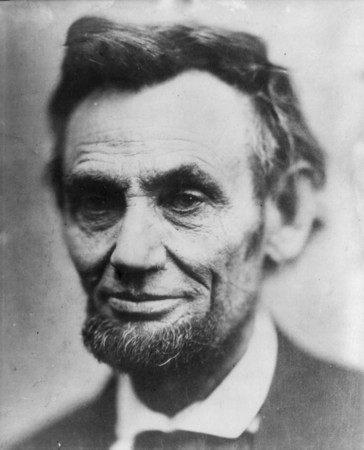
John Wilkes Booth shot President Abraham Lincoln on this date.
- What motivates assassins?
- President John F. Kennedy, Senator Robert Kennedy, Governor George Wallace and President Ronald Reagan were all victims or would-be victims of assassins in recent history. Why do you think such violence was directed at these men?
- Clip one on “assassins” (where did the word come from?)
- Clip two on “assassins” (why do they want to kill us?)
I highly recommend the episode of TV series West Wing that aired a few days after the 9/11 attack: “Isaac and Ishmael”. (Currently available on Netflix streaming, as well as on Amazon Instant Video – free to Prime members.) It’s some thought-provoking commentary on the issues at the heart of much of the terrorist threats today. Whether you are religious or secular, liberal or conservative, I think there is great benefit in considering the dialog in this absolutely stunning presentation. Probably heavier than a small child needs, but great for children who enjoy discussing with you on important, real-world topics.
Also on this date in history:
1890: Pan American Day
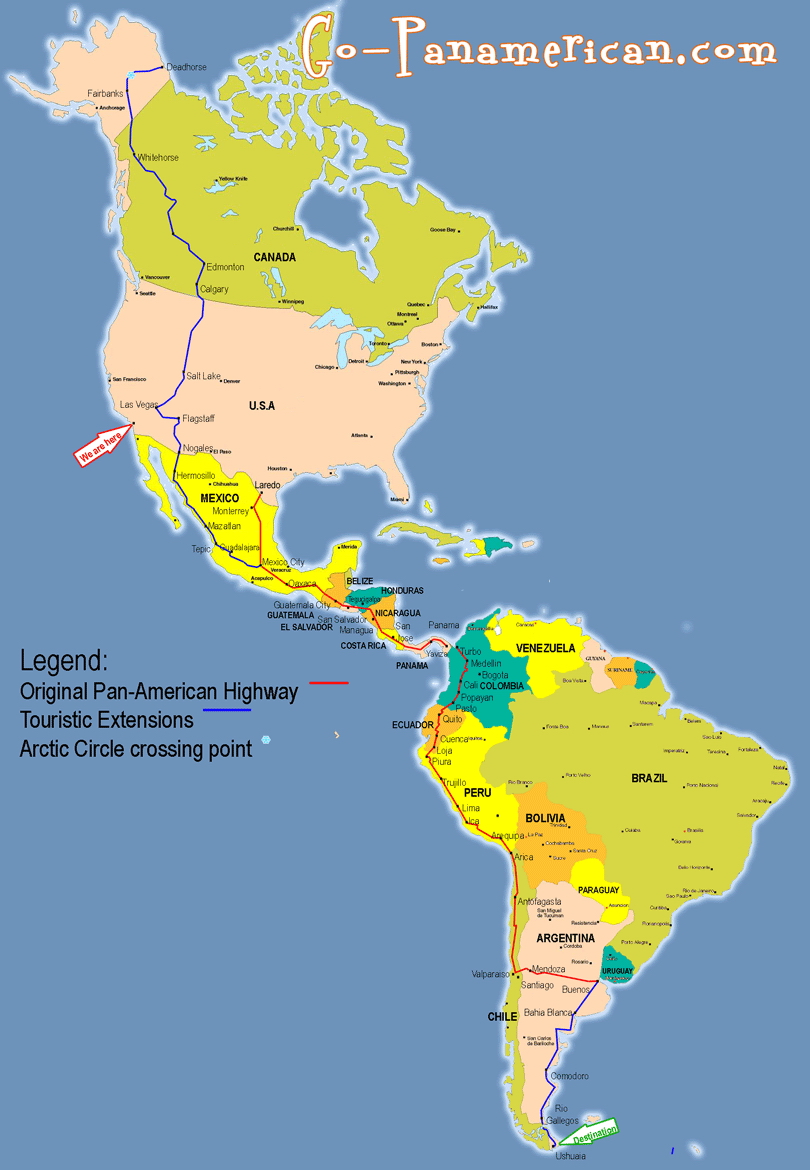
On this date, all the independent countries of the Western Hemisphere resolved to form an organization dedicated to peace and cooperation. Known as the Organization of American States (OAS), it is today the oldest international organization the world. Pan American Day, first observed in 1931, provides students with an opportunity to learn about countries in the western hemisphere.
Resources:
- Make a flag display
- Explanation and declaration of Pan American Day
- OAS children’s page
- Student’s Pledge on Pan American Day, by Gabriela Mistral
- Make a meal with elements from various countries of the OAS
- Prepare an OAS geography trivia game
This week in history instigates discussions and projects that expand your child’s wisdom, understanding and application of the things she learns.
April 15
1452: Birthdate of Leonardo da Vinci
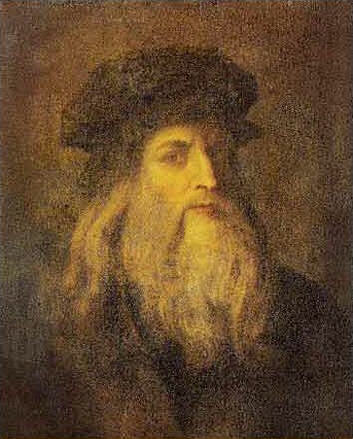
“I have been impressed with the urgency of doing.
Knowing is not enough; we must apply.
Being willing is not enough; we must do.”
When the name Leonardo da Vinci comes up, one immediately thinks of his great achievements as a painter and sculptor.
These include:
The portrait of Mona Lisa, which hangs in the Louvre Museum in Paris, France,

and
The Last Supper, a fresco, in Santa Maria delle Grazie in Milan, Italy.
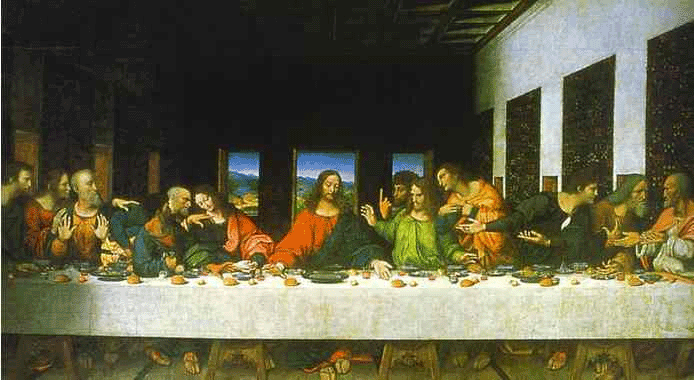
But da Vinci’s interests ranged widely. As a scientist he is famous for anticipating important discoveries about blood circulation, the special functions of the brain, and several modern inventions such as the airplane, tank, submarine and canon.
He was born in the mountain village of Vinci, near Florence. He died on May 2, 1519.
Resources:
- Fun LdV website with tons of resources
- Leonardo the paleontologist and biologist
- Collection of paintings by LdV
- Leonardo da Vinci, Stanley
- Who Was Leonardo da Vinci?, Edwards
- Amazing Leonardo da Vinci Inventions You Can Build Yourself (Build It Yourself series), Anderson
- Leonardo da Vinci for Kids: His Life and Ideas, 21 Activities, Herbert
- Da Vinci math experiment
Also on this date in history:
1912: The sinking of the Titanic
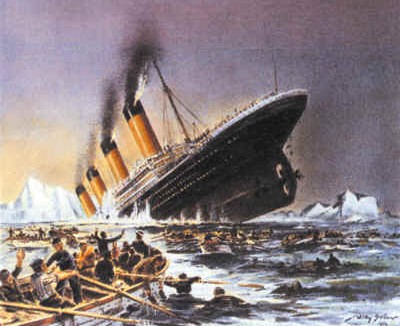
The Titanic, a large, lavish, “unsinkable” boat, sank after hitting an iceberg in the North Atlantic, kiling 1,517 passengers because the ship had not carried enough lifeboats.
On September 1, 1985, the Titanic appeared again in the headlines, when a French-American expedition led by Dr. Robert Ballard discovered the legendary lost ship sitting proudly upright on the ocean bottom, 2.5 miles below the surface.
Resources:
- Encyclopedia Titanica (website with lots of categorized information)
- Inside the Titanic (A Giant Cutaway Book), Brewster
- The Story of the Titanic As Told by Its Survivors, Winocour
- Titanic – The Complete Story, McCallum
Ideas for writing or discussion:
- Have you ever had an accident or problem that you weren’t prepared for (even though you were warned)?
- Why do we sometimes prefer to believe that the things we’re warned about aren’t likely to happen?
- What types of things do people do to prepare for things that are unlikely to happen?
- Why do they do these things?
- When is worry helpful?
- When is it unhelpful?
- Is there anything you or a family member does differently now than before some misfortune or accident?
- Why the change?
This Week in History saves you time and frustration, and builds your mentoring confidence.
April 16
No Spoiler Here. I’ll tell you what today is after we’ve solved the riddle:
Though it can take years off a life
and affect the heart,
I can turn everything upside down while making it right.
I am deadly contagious;
Everyone wants to see me…
What is “it”? What am I? (The “it” is defined here; stay tuned for the “I”!)
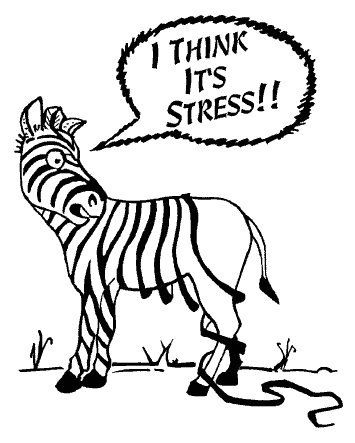
Today is National Stress Awareness Day!
(Not coincidentally, the day after taxes are due…)
- What is stress?
- What stresses affect you personally?
- Individual members of your family?
- How do you cope with stress?
- Can you think of three healthy ways to deal with stress, and three unhealthy ways?
- What illnesses and other risks are related to stress?
- Do something today to relieve stress–yours, or somebody else’s
- Enjoy this 16 minute award winning movie “Validation” – sure to put the concerns in perspective, put a smile on your face and a spring in your step. And remember…SMILE!
Are you feeling stressed today? If so…
Now, the “I”:
SMILE!
First get into a comfortable position.

Get a healthy treat.

Now contemplate your blessings: you could be doing this…

We all miss our mark somedays…

so smile…

Oh, you are doing great. Just great! Love that smile!
Riddle Answer:
A smile!
But not all stresses are emotional. Stress can be defined as:
Tension; a constraining force or influence; a force exerted when one body or body part presses on, pulls on, pushes against, or tends to compress or twist another body or body part; the deformation caused in a body by such a force.
In this context, what role does “stress” play in the music produced by:
- a drum
- a piano
- a guitar
- a violin
- a clarinet
Also: Stress means the Force per unit Area. It is a measurement of how forces flow through solid or semi-solid objects. So as the earth’s plates move and push against each other(or collide) they are exerting Forces that is related to Stress.
What role does stress play in earth science?
This Week in History helps you make connections between the subject areas–from music to math, from geography to world religions, from hobbies to science projects, and more.
Also, today is:
National Eggs Benedict Day

Eggs Benedict
INGREDIENTS
- 4 egg yolks
- 3 1/2 tablespoons lemon juice
- 1 pinch ground white pepper
- 1/8 teaspoon Worcestershire sauce
- 1 tablespoon water
- 1 cup butter, melted
- 1/4 teaspoon salt
- 8 eggs
- 1 teaspoon distilled white vinegar
- 8 strips Canadian-style bacon
- 4 English muffins, split
- 2 tablespoons butter, softened
DIRECTIONS
- To make Hollandaise: Fill the bottom of a double boiler part-way with water. Make sure that water does not touch the top pan. Bring water to a gentle simmer. In the top of the double boiler, whisk together egg yolks, lemon juice, white pepper, Worcestershire sauce, and 1 tablespoon water.
- Add the melted butter to egg yolk mixture 1 or 2 tablespoons at a time while whisking yolks constantly. If hollandaise begins to get too thick, add a teaspoon or two of hot water. Continue whisking until all butter is incorporated. Whisk in salt, then remove from heat. Place a lid on pan to keep sauce warm.
- Preheat oven on broiler setting. To Poach Eggs: Fill a large saucepan with 3 inches of water. Bring water to a gentle simmer, then add vinegar. Carefully break eggs into simmering water, and allow to cook for 2 1/2 to 3 minutes. Yolks should still be soft in center. Remove eggs from water with a slotted spoon and set on a warm plate.
- While eggs are poaching, brown the bacon in a medium skillet over medium-high heat and toast the English muffins on a baking sheet under the broiler. 5. Spread toasted muffins with softened butter, and top each one with a slice of bacon, followed by one poached egg. Place 2 muffins on each plate and drizzle with hollandaise sauce. Sprinkle with chopped chives and serve immediately.
Also on this date in history…
1924: Birthdate of Henry Mancini

Some of the most important and recognizable themes in contemporary music were written by this man. Follow the links for examples of his great work!
- Henry Mancini official website
- Baby Elephant Walk
- Romeo and Juliet
- Mission Impossible
- Pink Panther Theme (gotta love this one!)
Also on this date in history…
1889: Birthdate of Charlie Chaplin

Charlie Chaplin was one of the very first “movie stars”, and was beloved the world over for his character, “The Tramp”, a vagrant with the charm and manner of a refined gentleman.
This Week in History brings the Phases of Learning into focus.
April 17
1790: Death of Benjamin Franklin

“If you would not be forgotten, as soon as you are dead and rotten, either write things worth reading, or do things worth the writing.”
~ B. Franklin
- On Benjamin Franklin
- Franklin Activities
- Fun with Franklin
- The Autobiography of Benjamin Franklin (Dover Thrift Editions)
- Who Was Ben Franklin? (Who Was…?), Frader
- The Amazing Life of Benjamin Franklin, Giblin
- Benjamin Franklin: Young Printer (Childhood of Famous Americans), Stevenson
Printables:
- Franklin Word Search
- Franklin Crossword Puzzle
- Franklin Alphabet Activity
- Franklin Vocabulary Activity
- Franklin Tic Tac Toe cut out game
- Franklin Lightning Puzzle
As a young man in 1728, Franklin composed his own mock epitaph which read:
The Body of B. Franklin Printer;
Like the Cover of an old Book,
Its Contents torn out,
And stript of its Lettering and Gilding,
Lies here, Food for Worms.
But the Work shall not be whlly lost:
For it will, as he believ’d, appear once more,
In a new & more perfect Edition,
Corrected and Amended By the Author.
He was born on January 6, 1706.
Died 17
His actual gravestone would simply read:
BENJAMIN And DEBORAH FRANKLIN 1790
Here’s a link for unusual epitaphs of celebrities

- What is the value or writing your own epitaph, early in your life?
- In one sentence sum up your life.
- In one sentence write what you would like your life to be or who you would like to become.
- Write your own epitaph: make both a witty/silly version and one that is meaningful
- Consider how you would like to be remembered.
Also on this date in history:
1906: San Francisco earthquake of 1906

1906 U.S.A. Earthquake San Francisco 18th April 1906 : An earthquake, measuring 7.8 on the Richter scale, shook the town of San Francisco , California and Thirty thousand homes were either partially or wholly destroyed and an estimated 3,000 are reported dead. The earthquake set off a series of fires which swept through the city.
- What causes earthquakes?
- Does the area where you live have earthquakes?
- Do you know what to do to protect yourself in an earthquake?
- What kinds of problems follow an earthquake? (downed power lines, structures unstable, medical emergencies, fires, contaminated water source, missing persons, travel problems, interruption of ultilities, ….?)
- Are there topographical features in your area that are a result of seismic activity?
- Does your family have a plan for where to go, how to communicate, etc., in the event of a disaster?
Resources:
- PBS Earth Shaker Mountain Maker (Interactively manipulate the plates)
- FEMA Earthquake site (I’m impressed with this one – links to stories, history, math activities, and preparedness guides)
- NEIC (National Earthquake Information Center) – get up to date information about earthquakes around the world. This is written on a more scholarly level – very useful for research.
This Week in History motivates you and your students to greater excellence.
April 18
1775: “The British are Coming!”

Paul Revere began his famous ride to warn the American colonists that “the British are coming.” Revere left Boston at about 10:00 pm and arrived in Lexington at midnight, ridiing a borrowed horse, to warn Samuel Adams and John Hancock of the imminent danger. the event inspired Henry Wadsworth Longfellow to write one of his most famous poems, a moving ballad that became one of the best known poems in American literature, “Paul Revere’s Ride.”
From 1776 to 1779 Revere served as a Revolutionary soldier. He was also a craftsman of note and was the first American to discover the process of rolling sheet copper. He built the first copper rolling mill in the United States. Until that time all sheet copper had been imported. Revere was born in Boston on January 1, 1735 and died there on May 10, 1818. (see next week’s entry on 4/19)
(While this is great poetry, it’s not great history. Scroll down for “The Real Story” behind Revere’s famous ride…)
“Paul Revere’s Ride”

This is a great poem for reading aloud!
LISTEN, my children, and you shall hear,
Of the midnight ride of Paul Revere,
On the eighteenth of April, in Seventy-Five;
Hardly a man is now alive
Who remembers that famous day and year.
He said to his friend, “If the British march
By land or sea from the town to-night,
Hang a lantern aloft in the belfry arch
Of the North Church tower, as a signal light, –
One, if by land, and two, if by sea;
And I on the opposite shore will be,
Ready to ride and spread the alarm
Through every Middlesex village and farm,
For the country-folk to be up and to arm.”
Then he said “Good-night!” and with muffled oar
Silently rowed to the Charlestown shore,
Just as the moon rose over the bay,
Where swinging wide at her moorings lay
The Somerset, British man-of-war;
A phantom ship, with each mast and spar
Across the moon like a prison-bar,
And a huge black hulk, that was magnified
By its own reflection in the tide.
Meanwhile, his friend, through alley and street
Wanders and watches with eager ears,
Till in the silence around him he hears
The muster of men at the barrack door,
The sound of arms, and the tramp of feet,
And the measured tread of the grenadiers,
Marching down to their boats on the shore.
Then he climbed the tower of the Old North Church,
By the wooden stairs, with stealthy tread,
To the belfry-chamber overhead,
And startled the pigeons from their perch
On the somber rafters, that round him made
Masses and moving shapes of shade, –
By the trembling ladder, steep and tall,
To the highest window in the wall,
Where he paused to listen and look down
A moment on the roofs of the town,
And the moonlight flowing over all.

Beneath, in the churchyard, lay the dead,
In their night-encampment on the hill,
Wrapped in silence so deep and still
That he could hear, like a sentinel’s tread,
The watchful night-wind, as it went
Creeping along from tent to tent,
And seeming to whisper, “All is well!”
A moment only he feels the spell
Of the place and the hour, the secret dread
Of the lonely belfry and the dead;
For suddenly all his thoughts are bent
On a shadowy something far away,
Where the river widens to meet the bay, –
A line of black, that bends and floats
On the rising tide, like a bridge of boats.
Meanwhile, impatient to mount and ride,
Booted and spurred, with a heavy stride
On the opposite shore walked Paul Revere.
Now he patted his horse’s side,
Now gazed on the landscape far and near,
Then, impetuous, stamped the earth,
And turned and tightened his saddle-girth;
But mostly he watched with eager search
The belfry-tower of the Old North Church,
As it rose above the graves on the hill,
Lonely and spectral and somber and still.
And lo! as he looks, on the belfry’s height
A glimmer, and then a gleam of light!
He springs to the saddle, the bridle he turns,
But lingers and gazes, till full on his sight
A second lamp in the belfry burns!
A hurry of hoofs in a village street,
A shape in the moonlight, a bulk in the dark,
And beneath, from the pebbles, in passing, a spark
Struck out by a steed flying fearless and fleet:
That was all! And yet, through the gloom and the light,
The fate of a nation was riding that night;
And the spark struck out by that steed, in his flight,
Kindled the land into flame with its heat.
He has left the village and mounted the steep,
And beneath him, tranquil and broad and deep,
Is the Mystic, meeting the ocean tides;
And under the alders that skirt its edge,
Now soft on the sand, now loud on the ledge,
Is heard the tramp of his steed as he rides.
It was twelve by the village clock,
When he crossed the bridge into Medford town.
He heard the crowing of the cock,
And the barking of the farmer’s dog,
And felt the damp of the river fog,
That rises after the sun goes down.
It was one by the village clock,
When he galloped into Lexington.
He saw the gilded weathercock
Swim in the moonlight as he passed,
And the meeting-house windows, blank and bare,
Gaze at him with a spectral glare,
As if they already stood aghast
At the bloody work they would look upon.
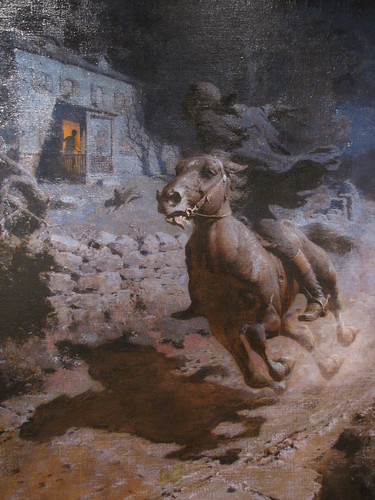
It was two by the village clock,
When he came to the bridge in Concord town.
He heard the bleating of the flock,
And the twitter of birds among the trees,
And felt the breath of the morning breeze
Blowing over the meadows brown.
And one was safe and asleep in his bed
Who at the bridge would be first to fall,
Who that day would be lying dead,
Pierced by a British musket-ball.
You know the rest. In the books you have read,
How the British regulars fired and fled, –
How the farmers gave them ball for ball,
From behind each fence and farm-yard wall,
Chasing the red-coats down the lane,
Then crossing the fields to emerge again
Under the trees at the turn of the road,
And only pausing to fire and load.
So through the night rode Paul Revere;
And so through the night went his cry of alarm
To every Middlesex village and farm, –
A cry of defiance and not of fear,
A voice in the darkness, a knock at the door,
And a word that shall echo forevermore!
For, borne on the night-wind of the Past,
Through all our history, to the last,
In the hour of darkness and peril and need,
The people will waken and listen to hear
The hurrying hoof-beat of that steed,
And the midnight-message of Paul Revere.
Henry Wadsworth Longfellow, 1860.
Resources:
- The Real Story of Paul Revere
- Biography – Paul Revere: The Midnight Rider (A&E DVD Archives)
Also on today’s date:
1968: UK London Bridge / Rennie’s bridge Sold To America
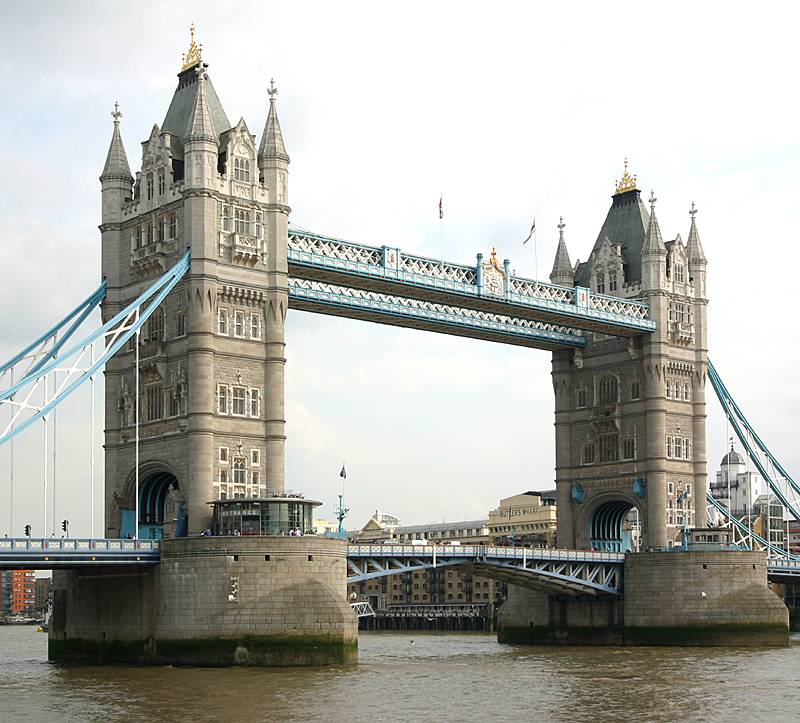
18 April 1968: London Bridge is sold for 1 million to an American Oil Magnate to be reassembled back at Lake Havasu City, Arizona. The bridge was disassembled, and each piece was numbered to aid re-assembly.

Resources:
Why subscribe to This Week in History?
-
it makes learning fun
-
it provides correlated resources for co-ops, classrooms and family learning
-
it cultivates cultural literacy
-
it helps fill in the gaps
-
it harmonizes with Unschooling, Charlotte Mason, Montessori, Trivium/Quadrivium, IEW, eclectic, classical, TJEd, and so on.
For pennies a day you have a world of inspiration in your kidschool.